Catalpa, Cattails
& Kudzu
Things You’ll See When You Visit
Mississippi
(although
not necessarily indigenous to Mississippi)
Catalpa (Catalpa bignonoides) a.k.a. Indian Bean Tree: From Encyclopaedia Britannica
-- any of 11 species of trees in the genus Catalpa
(family Bignoniaceae), native to eastern Asia, eastern North America,
and the West Indies. Catalpas
have large, attractive leaves and showy, white,
yellowish, or purplish flowers. The catalpa fruit is a long cylindrical pod bearing numerous seeds with
white tufts of hair at each end. The common catalpa is C. bignonioides,
which yields a durable timber and is one of the most widely planted ornamental species.
The
name catalpa (pronounced ketal'pe) comes from the
name given to a tree by the Native American tribe, the Catawba (keto'be or cuh-TAW-buh) of South Carolina. It is
said that the Indians smoked the bean pods for a hallucinogenic effect, so the
tree became known as the "Indian Cigar Tree", the Indian bean, and
smoking bean. Catawba tribes are also
known as Issa and Esaw. The name Catawba means “River People.”
In the late 1700s,
this tree was planted all over the Eastern United States
with southwest Georgia,
south Alabama,
and south-central and southeast Mississippi
being the original native ranges. The largest trees found measured 70
feet tall by 70 feet wide in Texas, and 75
feet by 75 feet in Mississippi, with a
relatively short life span of 70
years. It is said the tree could grow as tall as 100
feet.
The Southern catalpa is smaller than the Northern catalpa and reaches about 30 to 40
feet tall.
The
heartwood of the Southern catalpa is extremely heat resistant and is used for
fence posts and rails. Its soft straight-grained and low shrinkage is valuable
also and occasionally furniture parts are fashioned from catalpa. The wood is
faintly aromatic.
The catalpa trees are the only host for the catalpa
sphinx moth. This moth larva - known as the catalpa
worm -- devours the leaves of the tree and often completely defoliates the
tree. Defoliated catalpas produce new
leaves readily and trees usually refoliate promptly.
Adult moths first appear in March to April and deposit eggs ranging from 100 to 1,000
on the underside of the leaves. Eggs hatch in 5-7
days and young larvae feed together as leaf skeletonizers
until they are about three inches long. They then drop to the ground.
Southern trees produce fruit that are long, slender, thin-walled, pod-like
capsules that dangle from the ends of twigs. They look like cylindrical pencils
or cigars about 1/3 inch in diameter and 6-16 inches
long. The fruit dries to a brownish color and eventually splits along two
lengthwise seams. The fruits mature by October and are held on the tree until
spring.
Trees begin to flower by age seven and are producing good seed crops by age 10. Seeds are naturally shed in
late winter as the drying fruits split. Collection should occur after the fruit
has dried and turned brown. If 10 pounds of
air-dried fruit are collected, expect 2-3
pounds of seeds, which are about 40,000
individual seeds. Seeds can be stored under cold, dry conditions for up to two
years. Sow seeds in spring under 1/8 inch soil and light mulch. Once
sowed, seeds germinate within two weeks with 90% germination potential.
The catalpa worm, a green caterpillar that lives on
the catalpa tree, is well known as a tree pest, but is better known to some
for its attractiveness to catfish. References to their collection as bait
reportedly date back to the 1870s.
Tough in texture, they sport a black head and tail with a neon strip down
either side of its back. When put on a hook, which according to some should be
a circle hook with heavy sinkers to make sure the bait is on the bottom, a
bright fluorescent green fluid oozes from its body that smells sweet, which is
its attractiveness. It is also reported to "wiggle forever on a
hook." This sweet aroma and liveliness of this worm make it very appealing
to fish.
Harvesting the worm is best from April through November, with the largest
hatches produced in late spring and again in late summer. A single tree may
hold 200 worms. To
gather the worms, place a tarp or piece of plastic under the tree and shake it
until the worms fall off.
The worm can be preserved alive by
placing it in cornmeal or sawdust and packing it in a glass jar and frozen
indefinitely. When thawed, they become as lively as the day they were
frozen. This is because their metabolism slows down while eating and,
therefore, freezes in its natural state. Some fishermen report that it is
better to freeze them in water in lots of 25. Thawed out, they turn black and soggy, but do
not seem to lose their appeal to catfish.

Cattails:
(Typha angustifolia) a.k.a. Bulrush, reed
mace -- From Encyclopaedia Britannica -- any of
several flowering plants distinguished by cylindrical
stalks or hollow, stemlike leaves. They are found
in temperate regions and particularly in moist or shady locations. The rush
family (Juncaceae) includes Juncus,
the common rushes, and Luzula, the woodrushes. Common
rushes are used in many parts of the world for weaving into chair bottoms,
mats, and basketwork, and the pith serves as wicks in open oil lamps and for
tallow candles (rushlights). J. effusus,
called soft rush, is used to make the tatami mats of Japan. The bulrush, also called
reed mace and cattail, is Typha angustifolia,
belonging to the family Typhaceae; its stems and
leaves are used in North India for ropes,
mats, andbaskets. The horsetail genus (Equisetum) is
called scouring rush, or Dutch rush, because the plants' silica-laden stalks
are used for scouring metal and other hard surfaces. Flowering rush is Butomus umbellatus (family Butomaceae). The sweet rush, orsweet
flag, is Acorus calamus
(family Araceae).
Kudzu:
(Pueraria lobata) From Encyclopaedia
Britannica -- twining perennial vine that is a member of a genus
belonging to the family Leguminosae. The kudzu is a
fast-growing, woody, somewhat hairy vine that may grow to a length of 18
m (60 feet) in one
season. It has large leaves, long racemes with late-blooming reddish purple
flowers, and flat, hairy seed pods. The plant is native to China and Japan, where it
was long grown for its edible, starchy roots and for a fibre
made from its stems. The kudzu was transplanted to North
America with the intention of using it to anchor steep banks of
soil and thereby prevent erosion. The plant has become a rampant weed in parts
of the southeastern United
States, however, since it readily spreads over trees and shrubs as well as
exposed soil. The kudzu vine is a useful fodder crop for livestock, however, as
well as an attractive ornamental. Northern winters tend to kill the plant's
stems but allow the roots to survive.
DESCRIPTION: Kudzu is a
climbing, semi-woody, perennial vine in the pea family. Deciduous leaves are alternate and compound, with
three broad leaflets up to 4 inches across.
Leaflets may be entire or deeply 2-3 lobed with hairy margins. Individual flowers, about 1/2 inch long, are purple,
highly fragrant and borne in long hanging clusters. Flowering occurs in
late summer and is soon followed by production of brown, hairy, flattened, seed
pods, each of which contains three to ten hard seeds.
BACKGROUND: Kudzu was introduced into the U.S. in 1876 at the Philadelphia
Centennial Exposition, where it was promoted as a forage crop and an ornamental
plant. From 1935
to the mid-1950s,
farmers in the south were encouraged to plant kudzu to reduce soil erosion, and
Franklin D. Roosevelt's Civilian Conservation Corps planted it widely for many
years. Kudzu was recognized as a pest weed by the U.S. Department of
Agriculture and, in 1953,
was removed from its list of permissible cover plants.
Pokeweed:
(Phytolacca
Americana) a.k.a. Poke (Polk)
Salad: a
coarse American perennial herb (of the family hytolaccaceae,
the pokeweed family) with racemose
white flowers, dark purple juicy berries, a
poisonous root, and young shoots sometimes used as
potherbs.
Polk Salad Annie
Written and Originally Recorded by Tony Joe
White
[spoken]
If some of ya'll never been down South too much...
I'm gonna tell you a little bit about this,
So that you'll understand what I'm talking about
Down there we have a plant
That grows out in the woods and the fields,
Looks somethin' like a turnip green.
Everybody calls it Poke salad. Poke salad.
Used to know a girl that lived down there and
she'd go out in the evenings and pick a mess of it...
Carry it home and cook it for supper,
'Cause that's about all they had to eat,
But they did all right.
[sung]
Down in Louisiana
Where the alligators grow so mean
There lived a girl that I swear to the world
Made the alligators look tame
Poke salad Annie, poke salad Annie
Everybody said it was a shame
Cause her mama was working on the chain-gang
(A mean, vicious woman)
Everyday 'fore supper time
She'd go down by the truck patch
And pick her a mess o' polk salad
And carry it home in a tote sack
Poke salad Annie, 'gators got you granny
Everybody said it was a shame
'Cause her mama was aworkin' on the chain-gang
(a wretched, spiteful, straight-razor totin' woman,
Lord have mercy. Pick a mess of it)
Her daddy was lazy and no count
Claimed he had a bad back
All her brothers were fit for
Was stealin' watermelons out of my truck patch
Poke salad Annie, the
gators got your granny
Everybody said it was a shame
Cause her mama was a working' on the chain gang
(Sock a little polk salad to me, you know I need a
mess of it)
Rabbit Tobacco: (pseudognaphalium obtusifolium) a.k.a. Sweet Everlasting, Sweet White Balsam,
Fragrant Life Everlasting, Fuzzy Gussy
This is a
herbaceous plant, it is a annual which can reach 80cm in height (30inches). It is sometimes a biennial. The plant is covered with a cottony down. The leaves are alternate. Each leaf is entire, narrow and, like the rest of
the plant, wooly . The flower parts
are not discernable with the naked eye and are up to 1cm long (0.4
inches) and are up to 0.5cm
wide (0.2 inches). They are whitish to light brown. Blooms first
appear in mid summer and continue into mid fall.
There are
many accounts of Everlasting being smoked in place of tobacco by Native
Americans and settlers alike and the smoke held a spiritual or mystic power for
many Indians. The Cheyenne
dropped the leaves on hot coals and used the smoke to purify gifts to the
spirits. Cheyenne warriors chewed the leaves and rubbed their bodies with it to
strengthen and protect them in battle. The Menomini
used the smoke after a death to keep the ghost of the dead from bringing
nightmares and bad luck to the surviving family members. The Potawatomi and the
Chippewa use the smoke to drive away sprits (witches) from their dwellings. The
Cherokees used it in sweat baths. It was also thought by many tribes that the
smoke had a restorative power that could revive the unconscious or paralyzed.
The fresh juice has some reputation as an aphrodisiac.
Photo 1
Photo 2 Photo3 Photo4
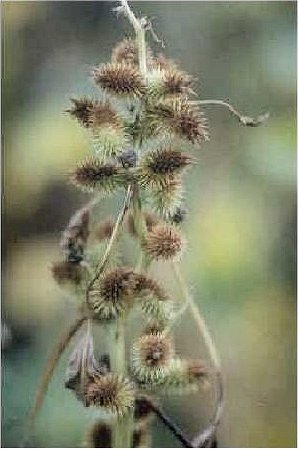
Cocklebur: (xanthium
strumarium)
The
cocklebur has large and broad leaves, light and bright green in color in an
alternate pattern with irregular lobes and relatively inconspicuous
teeth. Stems turn maroon to black when mature, with an elliptic or egg shaped fruit clusters growing nestled around the stem.
These are the part you can’t miss, as “nature’s Velcro” covers these fruit with
small hooks that grab on to socks, hair, and anything else they can latch
onto. Common cocklebur is a coarse, erect, annual herb up to 20 dm tall. The
stems are tough with short dark streaks or spots and covered with coarse
hairs. The leaves are long petiolate, alternate,
broadly ovate, margins toothed or shallowly lobed, surfaces rough-pubescent.
The plant is monoecious: the male flowers are in inconspicuous
heads clustered at the tips of branches; the female flowered heads are
axillary, greenish in color with the 2
flowers in the head enclosed by the involucre. The fruit is a distinctive hard
brown ovoid bur terminated by 2
beaks and covered with hooked spines.
Beggar Lice: (desmodium obtusum) a.k.a. Beggar’s
Lice, Tick Trefoil
Beggar's Lice, also
known as Tick Trefoil, is the weed that covers your clothing with flat, eye-shaped,
clinging seeds when you've been walking in
fields or open woods during late summer and fall. The stickiness of the seed
pod is due to its covering of fine hairs. The
pod is segmented, with each segment containing a single seed, and the segments
break apart easily. The genus name, Desmodium, is
Greek, meaning "band" or "chain", referring to these
segmented seed pods.
Johnson Grass: (sorghum halepense) a.k.a. Egyptian Millet
Johnson grass is a tall, coarse, grass with stout
rhizomes. It grows in dense clumps or nearly solid stands and can reach 8 feet (2.4 meters) in height. Leaves
are smooth, 6-20
inches (15.2-50.8
cm) long, and have a white midvein. Stems are pink to rusty red near the base. Panicles
are large, loosely branched, purplish, and hairy. Spikelets
occur in pairs or threes and each has a conspicuous awn. Seeds are reddish-brown and nearly 1/8 inch (0.3 cm)
long. Named after William Johnson
(died 1859),
American agriculturalist.
Johnson grass is a very
aggressive, perennial grass. It occurs in dense clumps that spread by seed and
rhizomes to form nearly pure stands. The thick rhizomes live over winter and in
the spring send out new, white, spur-like shoots. In clay soils 80% of the rhizomes are in the top
four inches of soil. In sandy loam soil, 80% occur in the top six inches. However, rhizomes
may grow downward through cracks to a depth of 10 to 20 inches. The
grass leaves emerge late in spring and the plant forms seed by July 1. A single plant may produce over 80,000
seeds per year. Stems and leaves die back after the first frost, but the dead
litter often covers the ground all winter. Rhizome cuttings commonly form new
plants, making it very difficult to eradicate. It spreads rapidly and is not
affected by many of the agricultural herbicides.
Dogfennel: (Eupatorium
capillifolium)
This is a perennial weed with a
taproot. It can grow 3 - 9 feet with crowded branches
near the top. The leaves are divided into several thread-like segments. It is found frequently on the sides of the
road, and in unused pastures. The leaves
are very strong in scent when crushed.
They reproduce readily by seed and will re-grow from the woody
base. It is generally found from New Jersey to Florida and then again
west to Texas
and Arkansas. Some gardeners have cultivated it for its
airy look in the flower bed. In fields, crop rotation and land management will
control this weed. It can be eliminated in one season. Dogfennel is
thought to be a natural mosquito repellant.
Cogongrass: (Imperata cylindrica)
Cogon grass has been
ranked as one of the ten worst weeds of the world. In tropical and subtropical
regions around the globe, this aggressive,
rhizomatous perennial is generally considered a pernicious pest plant due
to its ability to successfully disperse, colonize, spread, and subsequently
compete with and displace desirable vegetation and disrupt ecosystems over a
wide range of environmental conditions.
These characteristics and consequences of cogon grass infestations are
similarly evident even within the native or endemic range in the Eastern Hemisphere, as it has long been considered one of
Southeast Asia’s most noxious weeds. Since the introduction of cogon grass into
Alabama around 1912,
and Mississippi and Florida in the early 1920s, infestations in the southeastern United
States have created pest problems in lawns, pastures, golf courses, roadways,
railways and other right-of-ways, mine reclamation areas, plantations, forests,
and recreational and natural areas. Although the transport of this plant into
and throughout the United
States is prohibited by federal law, cogongrass continues to spread throughout the southeast
gulf coast threatening forests, rangelands, natural areas, roadsides, and
residential areas. The cogongrass blade is shown here.
Horse Apple Trees: (Maclura pomifera)
Although we have nicknamed them “horse apples,” the
actual name is the Osage Orange Tree. A
more correct nickname is the “hedge apple.”
The great mystery about osage-orange is the
identity of the animal or animals which ate the fruit and transported the
seeds. That there must have been one is self-evident: the fruits are too large for the seeds to have been
moved by any other means. Cattle will eat them, and buffalo may have been
important. Osage orange has remarkable chemical properties, including the
presence of 2,3,4,5-tetrahydroxystilbene,
whose toxicity to fungi may account for the exceptional decay resistance to
decay. The thorns and the huge fruits discourage its
use. It is also not very attractive of form.
The only thing which recommends osage-orange is its
extraordinary hardiness: osage-orange will grow
anywhere. Osage-orange flowers in
June and is dioecious. The huge globose
yellow-green fruits ripen in mid fall and drop to the ground. There are
presently no native herbivores which eat the fruit and disseminate the seed,
and the original vectors are unknown, even within the native range of the
species. Seeds germinate in spring or enter the seed bank. Osage-orange also
regenerates from stump sprouts. Growth is moderately fast. Osage-orange trees
live for 100-150 years, and are typically 40'x3' (Champion 68'x7.7'). Here is a photo
of the Osage Orange Leaf.
Coachwhip Snake:
(Masticophis
flagellum)
Also called the “racer,” name for several related swift,
slender snakes, especially those of the genus Coluber.
All of the racers are nonpoisonous, nonconstricting,
day-active snakes. The black racer, C. constrictor, is easily confused
with the constricting black rat snake, or pilot black snake (Elaphe obsoleta),
which may account for its misleading Latin name. The black racer is satiny
black, with a white patch on the chin, and may reach a length of 6
ft (180 cm) and a
diameter of 11/2 in. (4 cm).
It is found in E North America from Canada to Florida. It feeds
primarily on small rodents, frogs, and young snakes, and is a valuable
destroyer of vermin. One of the fastest-moving snakes, it has been clocked at
over 31/2 mi (5.6 km)
per hr. An aggressive snake, it will bite repeatedly if cornered; however, it
can be tamed. The young, hatched from eggs, are pale gray, spotted with brown.
The name is also applied to the related indigo snake (Drymarchon
corais) and to some of the coachwhip snakes (Masticophis). The speckled racers are species of the
genus Dryombius. All of the racers are
classified in the phylum Chordata, subphylum
Vertebrata, class Reptilia, order Squamata,
family Colubridae.
Paw
Paws:
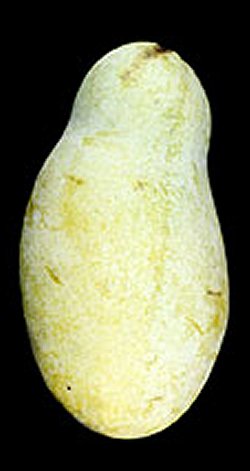
(Asimina Triloba) a.k.a. dog banana, Indian banana, possumhaw
Pawpaw
is a small tree found in the understory
of rich sites on poorly to well drained, moist soils. It is always found
in clumps, and reproduces clonally from the roots. Very tolerant of
competition. The name is probably
derived from papaya, for the vague resemblance of the fruit to Carica papaya. Fruit are produced in clusters and are oblong to
banana-shaped, providing insight into the origin of one of A. triloba's early names, "Indiana banana." Fruit size ranges from
quite small (20 g) to over 450
g. Skin is typically smooth and thin, ranging in color from
green to bright yellow at maturity and turning brown or black after a frost. The
fruit may be eaten when it becomes soft although some prefer to wait until
after the skin has darkened. Flesh is custard-like in texture with flavor
resembling cherimoya (Annona cherimola) or soursop (Annona muricata).
Flesh color is typically orange but infrequently may be white. Large fruit
usually have 10 to 15 large black seeds.
Peterson
et al. (1982)
evaluated the composition of pawpaw fruit and concluded that the fruit have a high
nutritional quality compared to temperate fruits such as apple, peach, and
grape. All commercially important fruit in the Annonaceae
have relatively short shelf-lives. As Annonas are
used in juices, ice cream, and other processed products similar processing may
also be applicable to pawpaws. The pawpaw is the largest fruit native to the
United States. Pawpaws are native
to 21 states in the
eastern United States,
although they are most commonly found in Indiana,
Ohio, Illinois, and Michigan. A member of
the Annonaceae (tropical custard apple family), the
pawpaw, unlike its tropical relatives, is hardy to -30°F.
The pawpaw was a popular fruit in the United States early in the 20th century, but has been
relegated to a local delicacy. The yellow-brown fruits are about the size of a
potato with a texture like a very ripe banana, hence their name "Indiana banana."
The taste is reminiscent of papaya with pineapple overtones, with bits of
banana and mango. It has a very sweet, pleasant, tropical fruit flavor that is
like no other and is very rich, making it unlikely that you will want to eat
more than one. Extremely aromatic when cut open, pawpaws
will fill a whole room with their fruity aroma.
One of the
difficulties with pawpaws is that they deteriorate
just as they are the tastiest. The intensity of
fruitiness peaks at ripeness, but then the fruit drops. The fruits do ripen
off the tree, but because they ripen quickly and bruise easily, they are almost
impossible to get to market in a usable form.
Paw Paw Leaf Paw Paw Flower
Maypop:
(Passiflora incarnata)
a.k.a. Purple Passionflower, apricot vine
Maypop is a fast growing perennial vine that employs
tendrils to grab hold of adjacent shrubs, structure and other supports to lift
itself to heights of 8-12
ft (2.4-3.7
m). The large serrated leaves grow 5-6 in (13-15 cm)
wide by 6 to 8
in (15-20
cm) long. They typically have three to five lobes and are
arranged alternately on the stem with flowers and branches emerging from the
axil (the base of the leaf stem where it attaches). All of the passion flowers have beautifully complex blossoms and maypop is no exception.
These have 2-3
in (5-7.6
cm)diameters and are composed of 10 white tepals
arranged in a shallow bowl shape above which is arranged fringe of purple and
white filaments, called the corona. In the center is the white fleshy stigma
surrounded by five stamens. The maypops are the size of a small hen's egg with
yellow-green skin juicy, but seedy pulp.
Maypop is native to southeastern United States
and is often seen growing on the edges of fields, along side ditches and other
sunny, moist and fertile places.
Catfish:
Of the 30
American species the largest and most important is the blue, or Mississippi, catfish (Ictalurus furcatus),
an excellent food fish weighing up to 150 lb (70
kg). Best known is the smaller channel catfish (Ictalurus punctatus), which reaches 20
lb (9 kg) and has a
deeply forked tail and slender body. The stonecat (Noturus
flavus),
10 in. (25.4
cm) long, is found in clear water under logs and stones. The
bullheads, or horned pouts, are catfish of muddy ponds and streams, feeding on
bottom plants and animals. Bullheads have square or slightly rounded tails and
may reach 1 ft (30
cm) in length and 2 lb (0.9
kg) in weight. The black, yellow, and brown bullhead species
are common in the waters of the central and eastern states.
Blue Catfish vary in color
from slate-blue to grayish brown on their back and sides, fading to a whitish
belly. In muddy waters, some individuals appear albinistic,
the pale skin evoking the common nickname “white cat.” They are often confused with
channel catfish. Both have forked tails and similar coloration, but blues lack
the small black spots punctuating the sides of young channels, and their anal
fin has a straight edge, with 30
or more fin rays
Channel Catfish reach a
maximum size of nearly 60 pounds and look
much like other catfish in that they have 'skin' instead of scales and whiskers
around the mouth. Channel catfish are often mistake for Blue Catfish. It is
easy to tell them apart by looking at the anal fin. On a Blue Cat the anal fin
has the look of having been cut with scissors, whereas; on the Channel Cat the
fin anal fin is not as straight, having some curve through out its entire
length. Channel Catfish occur throughout the Mississippi River Valley,
and down to the Mexico
border. Channel Catfish are the most commonly raised aquaculture species in the
U.S.
Bullhead Catfish don’t
get as big as the Blue, Channel or Flatheads (~40-60lbs.),
as the largest is the White Bullhead catfish around 10lbs. although they aren’t as small as the
very small madtoms, which only weigh a few ounces.
Here is a picture of a Black Bullhead (Ameiurus melas). The young catfish or "squealers"
tend to move in schools which are often guarded by a parent but can be subject
to mass predation. You might catch them during day light hours, however
typically catfish fish feed at night.
Other varieties are the Yellow Bullhead and the Brown Bullhead.
Flathead
Catfish (Pylodictus olivaris) have dark to
olive brown with dark brownish mottlings on sides;
anal fin is very short and tail fin is square or slightly notched; head broad
and flat.
Crawdads: a.k.a. crawfish,
crayfish, mudbugs
Crayfish, also called crawfish
or crawdad, or mudbugs, are closely related to the lobster. More than half of
the more than 500
species occur in North America, particularly Kentucky (Mammoth Cave) and Louisiana in the Mississippi basin. Crayfish also live in Europe, New
Zealand, East Asia
and throughout the world, including the Tristan da Cunha Islands.
Nearly all live in freshwater, although a few survive in salt water. Crayfish are characterized by a joined head
and thorax, or midsection, and a segmented body, which is sandy yellow, green,
or dark brown in colour. The head has a sharp snout,
and the eyes are on movable stalks. Crayfish are usually about 7.5
cm (3 inches) long. There are at least 65 known species of crawfish
in Mississippi. Crayfish are part of the order Decapoda constituting the families Astacidae
(Northern Hemisphere), Parastacidae, or Austroastracidae (Southern Hemisphere). The most common
genera of North America include Procambarus, Orconectes, Faxonella, Cambarus, Cambarellus, and Pacifastacus. Austropotamobius is the most common genus of Europe. The genus Astacus
occurs in Europe, the genus Cambaroides in East Asia.
The arthopod class also includes centipedes,
crustaceans, insects, millipedes, mites, scorpions and spiders.
Boll
Weevil:
(Anthonomus grandis)
The boll (bōl)
or cotton boll weevil , cotton-eating weevil , or snout beetle, is probably of Mexican or Central
American origin. It appeared in Texas about 1892 and spread to most
cotton-growing regions of the United
States. Over the years the weevil became a
significant pest, destroying about 8%
of the annual U.S.
cotton crop. Boll weevil devastation was a major reason for diversification of
the South's historic cotton economy. In 1978, however, the U.S. Dept. of Agriculture began a
concerted eradication campaign. By the end of the century the weevil had
disappeared from from most of the nation except Texas, Louisiana, and Mississippi, where the campaign
continued. The young adult is grayish,
darkening with age, and about 14 in. (6
mm) long, with a long snout for boring into the cotton boll, or
seed pod, where weevils feed on the cotton fibers. Weevils may also invade
cotton flower buds before they mature into bolls. Females lay eggs within the
bud or the boll, where pupation occurs. The larvae eat the entire contents of
the boll. Metamorphosis from egg to adult takes about three weeks; from 2
to 10 generations
occur each season. The weevil's resistance to some poisons, and the removal of
some poisons from the market, have encouraged Integrated Pest Management ,
e.g., the use of safer insecticides, synthetic growth regulators, and pheromone
traps, and the release of sterile males to frustrate reproduction. Adults are
also controlled by elimination of field litter, especially cotton stalks, in
which they overwinter. Short-season cotton, bred to mature early, escapes much
damage from weevil larvae. The boll weevil is classified in the phylum Arthropoda , class Insecta, order
Coleoptera, family Curculionidae.
Cotton:
The cotton plant belongs
to the genus Gossypium of the family Malvaceae (mallow family). It is generally a shrubby plant
having broad three-lobed leaves and seeds in
capsules, or bolls; each seed is surrounded with
downy fiber, white or creamy in color and easily spun. The fibers flatten
and twist naturally as they dry.
Cotton is of tropical origin but is most successfully cultivated in temperate
climates with well-distributed rainfall. All western U.S. cotton and as much as
one-third of Southern cotton, however, is grown under irrigation. In the United States
nearly all commercial production (especially Mississippi) comes from varieties of upland
cotton ( G. hirsutum ), but small quantities
are obtained from sea-island and American-Egyptian cotton (both belonging to
the species G. barbadense ). G. arboreum and G. herbaceum
are the chief cultivated species in Asia. Cotton is classified in the division Magnoliophyta , class Magnoliopsida,
order Malvales, family Malvaceae. Mississippi is one of
the largest cotton-producing states in the nation.
Okra: (Abelmoschus Medik)
Okra, fruit of a large vegetable plant
thought to be of African origin, was brought to the United States three centuries ago
by African slaves. The word, derived from the West African nkruma,
was in use by the late 1700s.
Grown in tropical and warm temperate climates, it is in the same family as the
hibiscus and cotton plants.
Okra is often available fresh
year-round in the South, and from May to October in many other areas. You can
also find okra frozen, pickled, and canned in some regions. When buying fresh
okra, look for young pods free of bruises, tender but
not soft, and no more than 4 inches long. It
may be stored in the refrigerator in a paper bag or wrapped in a paper towel in
a perforated plastic bag for 2
to 3 days, or it may
be frozen for up to 12
months after blanching whole for 2
minutes. Cooked okra can be stored (tightly covered) in the refrigerator for 3 to 4 days.
When cut, okra releases a sticky
substance with thickening properties, useful for soups and stews. Gumbos,
Brunswick stew, and pilaus are some well-known dishes
which commonly use okra.
Okra can be served raw, marinated in
salads or cooked on its own (boiled or fried), and goes well with tomatoes,
onions, corn, peppers, and eggplant. Whole, fresh okra pods also make excellent
pickles. Its subtle flavor can be compared to eggplant, though the texture is
somewhat unusual. Many people prefer breaded and fried okra, because the
slippery substance is less pronounced.
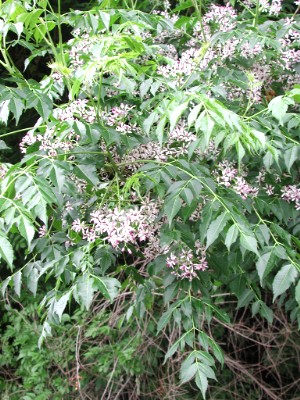
Chinaberry
Tree: (Melia azedarach) a.k.a. umbrella tree
Chinaberry
is a round, deciduous, shade tree, reaching 30 to 40 feet at maturity
and growing five to 10 feet during the
first and second year after seed germination.
Growth slows as the tree reaches 15
or 20 feet tall. It is successfully grown in a wide variety of
situations, including alkaline soil where other trees might fail. Truly an
urban survivor, Chinaberry has become naturalized in much of the south. Photos:
Leaves
Leaves and Fruit Fruit
More Coming Soon:
American Chestnut (Castanea dentata)
Armadillos
Bagworms
Bamboo
Bobcats
Bobwhite
Byram Bridge
Chinkapin (Castanea pumila)
Collard Greens
Coral Snake
Cottonmouth Moccasin
Cottonwood
Country Ham
Crepe Myrtle
Cypress
Elderberry
Fire Ants
Flowering Dogwood (Cornus florida)
Grits
Horse Chestnut (Aesculus hippocastanum)
Huckleberry (Gaylussacia baccata)
Locust trees
Mimosa
Mississippi Ag Museum
Mistletoe
Muscadines (Vitis rotundifolia)
Mustard Greens
Pecan Trees
Persimmon
Pignut Hickory
(Carya glabra)
Possums (Opossum)
Raccoons
Rattlesnake
Scuppernongs
Shagbark Hickory
(Carya ovata)
Sorghum Molasses
Southern Magnolia (Magnolia Grandiflora)
Spanish Moss
Swamp Chestnut (Quercus michauxii)
Sweetgum (Liquidambar styraciflua)
Trumpet Pitchers
Whipporwill
Wild Honeysuckle (Lonicera dioica)
Willow
Yellow Honeysuckle (Lonicera flavida)